National Tree Week 2010

‘Fiche is a Deich – Cuir Crainn Arís’ ~ ‘Twenty Ten – Plant Again’

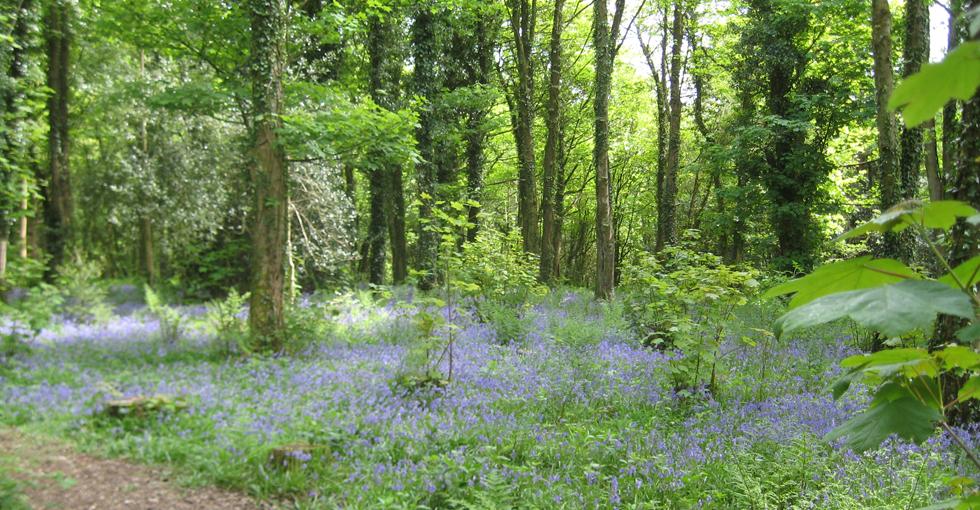
National Tree Week will take place from 7-13 March. The theme is ‘Twenty Ten – Plant Again’. We are asking people to make a renewed effort to go out and plant more trees during the week.

The aim of National Tree Week is to raise awareness about trees and encourage local communities and local authorities to participate in over 300 events which will take place around the country during the week. Events are organised all over the country which include forest walks, tree planting ceremonies, workshops, talks, competitions and even tree plantathons!

This year 15,000 trees, sponsored by Coillte will be distributed to community groups by local authorities all over the country – contact your local council for a supply of trees.
Every year a poster competition is held, this year’s winner is Fiona Cooney as student of NCAD, Thomas Street. Posters for the competition will be presented on Wednesday 3 March at Charleville Mall Public Library, North Strand by Éanna Ní Lamhna.

Despite the great advances in the past 100 years, Ireland remains one of the least wooded countries in Europe with only 10% of our land planted with trees compared to the European average of 40%. approx. This initiative will provide thousands of new jobs build our forestry industry and help improve our environment.

Why plant more trees?
• The forest industry is worth €1.65 billion annually.
• It is estimated that more than 10,000 people are employed in the industry mainly in rural Ireland.
• More than 17,000 farmers own and manage farm woodlands.
• Forests absorb carbon dioxide and give us oxygen
• The non timber benefits of forestry include bio-diversity, carbon sequestration, wood biomass energy and recreation.
• Ireland’s forests provide an opportunity to conserve bio-diversity at local and national level.
• Ireland’s forests provide a potential for wood to displace fossil fuels.
• Over 20 million visits are made annually to Irish forests.
• Over 200,000 people use forest trails for exercise.
• Trekking through forests is an important aspect of ‘Walking Tourism’ which attracts 500,000 visitors who spend €138 million annually.
• Wood is uniquely renewable among building material.

Do not despair, even if you have very little space to plant. By doing something as simple as planting one tree, you can play your part in helping the environment.

By thinking locally, we can act globally!

All Tree Week events are free and everyone is welcome to attend.

Source: http://www.treecouncil.ie/tree_council_programmes.htm#National
Over 100,000 Irish homes assessed under the Building Energy Rating scheme (BER)

Sustainable Energy Ireland (SEI) Press Release 21 February 2010

Figures released today (21 February 2010) from Sustainable Energy Ireland (SEI) reveal that over 100,000 Irish homes have had Building Energy Ratings (BERs) completed to date, the majority of which were completed since January 2009, the first year for full implementation of the BER scheme. Introduced in 2007 as part of a European Directive to improve the energy performance of homes, the rate of BER publications has steadily
increased in 2009 , averaging 300 per day, and indicating an increasing awareness of, and compliance with, the legislation.

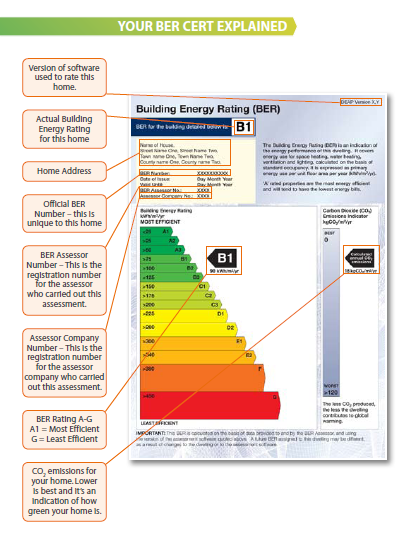
Sample of BER Cert ~ Photo Credit SEAI

Initially the scheme only applied to new homes, but since 1 January 2009 all homes being sold or rented are also required to have a BER certificate that shows prospective buyers or tenants the energy performance of the home. Research shows that landlords are the group most aware of the need for a BER certificate, with awareness now at 76%. While awareness is improving in most quarters, tenants looking to rent are the least aware of their entitlement to get a BER cert with awareness only at 38%. Commenting on the BER programme, Minister for Communications, Energy, and Natural Resources, Eamon Ryan TD said: “The BER Scheme is a practical scheme which helps current and prospective homeowners make informed choices when selecting or upgrading a property. The success of the scheme last year shows that the energy performance and efficiency of a property is becoming increasingly important for Irish homeowners. ” Minister for the Environment, Heritage and Local Government, John Gormley TD said: “The systems now in place and the increasing consumer awareness will be important factors in the continuous improvement of the energy performance of our building stock. This will help underpin future Building Regulation changes and efforts to upgrade existing buildings. ” Professor Owen Lewis, Chief Executive SEI, said: “Putting aside the difficult economic conditions in 2009, the first year of full operation of the BER scheme has been a successful one. However, there are many homes for sale or rent out there that have not yet been assessed, and need to be, if they are not to fall foul of the regulations. SEI is calling on people who are looking to buy or rent homes to insist upon receiving a BER certificate as their right, so they are fully informed of the energy performance before finalising any property transactions. ”

Source: http://www.sei.ie/News_Events/Press_Releases/100,000_BERs_issued.html

World First for UCC as Students Raise Green Flag

University College Cork (UCC) today(February 19th, 2010) became the first 3rd level educational institution in the world to be accredited with the prestigious international ‘Green Flag’ award. The award, presented by Minister John Gormley, on behalf of An Taisce, to UCC President Dr Michael Murphy, is a direct result of the Green-Campus programme, a student-led initiative undertaken by UCC students and staff over the last 3 years.

The Green-Campus programme, operated in Ireland by An Taisce, has seen the University save €300,000 in waste management costs, reduce waste to landfill by nearly 400 tonnes and improve recycling from 21% to 60%. Furthermore, UCC has conserved almost enough water this year to fill the equivalent of the Lough of Cork.

The first step was for the students to establish a Green-Campus Committee, in conjunction with the Buildings & Estates Department and academic staff. An environmental review followed. “There were absolutely no recycling facilities for students walking on the campus”, recalls Maria Kirrane, a student representative on the committee. “In fact, our very first action was to put on overalls and literally dive into the skips to see exactly what types of waste were being disposed of!”

In addition to staff recycling systems that previously existed, new recycling facilities for students are now available in front of the lecture halls, and in the canteens, where the staff is trained in minimising waste. Students in lecture theatres and laboratories are alerted to turn off lights and electrical equipment. College maintenance vehicles are now running on biodiesel. Carpooling has been introduced to facilitate lifts to and from campus. Enhanced Park & Ride and bike parking areas are designed to encourage more sustainable travel. Each year the Students Union holds a Green Awareness Week on campus, where real actions are supplemented by academic talks on environmental sustainability.

“It is quite a leap, transforming the Green-Schools programme, geared for the typical school of a few hundred students, to a complex campus of 130 acres, 16,000 students and almost 3,000 staff,” explained Dr Michael John O’Mahony of An Taisce. “In population terms UCC is bigger than your average Irish town, so bringing together all the necessary parties and practices to develop it into a sustainable Green-Campus was a real challenge.”

UCC President, Dr Michael Murphy said it is a source of great pride to the university, its staff and its students, that UCC has become the first third level institution in the world to be awarded the designation. “It is a wonderful achievement to have innovative thinkers among the staff and students in UCC all working towards the same objective.

“It was these students, who had been part of the Green Flag programme at secondary school level, who believed from the outset that the concept could be transferred successfully to an institution of UCC’s size and that by raising awareness throughout the university, we could, together, make a real difference.”

Mark Poland, Director of Building and Estates, added: “This initiative has provided a great forum for environmentally-conscious members of staff and students to assist in how we tackle our environmental responsibilities as a university community.”

An Taisce, on behalf of the Foundation for Environmental Education (FEE), granted the international accreditation after a rigorous assessment by an expert panel. UCC is now looking to build on the award. “We’d like to make it easier for students to cycle to college, possibly through a bike purchase scheme”, says Maria Kirrane. “Also, while UCC is a beautiful campus, many of the plants here are non-native. We’re looking to address biodiversity on campus.” In addition a programme to convert the college food waste into compost has commenced.

“There is a wide of range of environmental management programmes that a third level college could undertake. However, the Green Campus programme is unique because it is student-led and they are the key decision makers,” says Jan Eriksen, President of FEE. A number of other 3rd level institutions in Ireland will be applying for a Green-Flag shortly.

“This is about more than making a campus green”, continues Michael John. “Over the past 14 years, hundreds of thousands of students in Ireland have been brought up with Green-Schools, sometimes starting at pre-school, through primary schools and then second level. It is critical that the chain not be broken once they complete the Leaving Cert. It needs to continue into 3rd level, and from there into their professional as well as their personal lives so that they become life-long educators and ambassadors of sustainable living.”

Source:UCC Media and Communications – http://www.ucc.ie/en/mandc/news/fullstory,95898,en.html

UCC world’s first university to get Green Flag award

The award was presented for the Green Campus initiative which in the past three years has seen the university save €300,000 in waste management costs, by reducing waste to landfill by nearly 400 tonnes and improving recycling from 21% to 60%.

Furthermore, UCC has conserved almost enough water this year to fill the equivalent of the Lough in the city. The award was presented yesterday by Minister John Gormley, on behalf of An Taisce, to UCC president Dr Michael Murphy

In addition to staff recycling systems that previously existed, new recycling facilities for students are now available in front of the lecture halls, and in the canteens where staff are trained in minimising waste.

Students in lecture theatres and laboratories are alerted to turn off lights and electrical equipment.

College maintenance vehicles are now running on biodiesel and carpooling has been introduced to facilitate lifts to and from campus.

“It is quite a leap, transforming the Green Schools programme, geared for the typical school of a few hundred students, to a complex campus of 130 acres, 16,000 students and almost 3,000 staff,” Dr Michael John O’Mahony of An Taisce said.

Dr Murphy said it is a source of great pride to the university, its staff and its students, that UCC has become the first third-level institution in the world to be awarded the designation.

Source: Irish Examiner Saturday, February 20, 2010

Sustainable Development Model predicts potential environmental impact of future economic activity – EPA Press Release

Date released: Feb 18 2010, 12:05 PM

New research, published today by the EPA, shows how economic forecasts can be used to project waste generation and emissions of pollutants across Ireland.  The ISus (Irish Sustainable Development) Model is based on the work of a three-year study by the Economic and Social Research Institute (ESRI), funded under the EPA STRIVE research programme.

Speaking about the findings of the research, Dr. Mary Kelly, Director General, EPA said:

“This model, developed by the ESRI, is very welcome. We are all aware of the use of GDP and other statistics to measure economic change. These, however, leave many things unmeasured, including the environment.
The ISus model provides a link between economic forecasting and potential environmental impacts.  This enables us to use the expertise of the ESRI, in relation to economic data, and link this with the environmental data produced by the EPA. The results will aid policy and decision makers to diagnose environmental problems, identify pressure points, target policy interventions and assess their success.
For example, projections on the generation of biodegradable waste – how much and where – could be a very useful tool for planning the location and required capacity for waste management infrastructure in the future.”


 ISus covers more than 25 potential pollutants (to air, water and waste) emanating from 20 economic sectors.

Some of the findings from the research:

  • In relation to greenhouse gas (GHG) emissions: Ireland faces a significant challenge in meeting its target for 2020.
  • In relation to waste generation: projections from the model suggest that Ireland will also have great difficulty meeting EU limits on landfilling of biodegradable municipal waste.
  • In relation to carbon tax: it illustrates the spatial distribution of households likely to pay the highest tax, with those in the commuter belts likely to pay most.
    The data show that in the period 1990 – 2006, while the economy was growing strongly, some emissions (sulphur dioxide, carbon monoxide and volatile organic compounds) have fallen, while others (carbon dioxide from fossil fuel combustion, dioxins)  have increased.  ISus is able to attribute these changes to economic growth, structural changes in the economy and technological and behavioural change.


“The EPA is very happy to be working in collaboration with ESRI on this project and hopes to be able to reap the benefits of the work in producing forecasts and projections for environmental impacts based on different scenarios in the future”said Dr Kelly.

 The report Ireland’s Sustainable Development Model  is available on the EPA website.

The findings from this research are being presented today at a seminar on Environmental Projections and Policy for Ireland in the Economic and Social Research Institute.

Editor’s Notes:
This work was funded through the EPA’s Science, Technology, Research and Innovation for the Environment Programme (STRIVE). The programme employs a strategic and targeted approach to protecting and improving the natural environment through the provision and accumulation of scientific research and knowledge. Funding for the EPA STRIVE Programme is provided through the Department of Environment, Heritage and Local Government and the programme is administered by the EPA on their behalf.

http://epa.ie/news/pr/2010/name,27794,en.html

Carbon tax to hit commuter belt the hardest – Irish Independant
COMMUTERS will bear the brunt of the carbon tax and are likely to be hit with annual bills more than 10 times higher than those paid by people living in cities.

A new analysis from the Economic and Social Research Institute (ESRI) and the Environmental Protection Agency (EPA) shows that the annual carbon tax likely to be paid by someone living in inner-city Dublin will be €25 — but people living in the countryside could face bills of up to €275.

This is because many living outside the major cities are forced to drive to work because there is little or no public transport available. The report also found that rural houses tend to be bigger, and cost more to heat and that in cities, apartments share heat as it travels through a building.

carbon tax

The analysis published yesterday shows that the carbon tax, a key Green Party demand in its negotiations to enter Government, will not affect most of the party’s constituents.

The party has five TDs, with four based in Dublin.

Last December the first tranche of the tax was introduced in the Budget which saw motorists hit with a hike in fuel prices as petrol rose by 4 cent per litre and diesel by 5c.

Further pain is expected in May when the tax is applied to oil and gas for home heating, and the tax will also extend to the use of coal and peat.

The move is designed to discourage use of fossil fuels and to force behavioural changes where people would use public transport instead of the private car, and heat their homes using more energy-efficient heating systems such as wood-pellet stoves.

If successful, it would reduce the State’s dependency on imported fossil fuels and help reduce greenhouse gas emissions — the primary cause of global warming.

Co-author of the EPA/ESRI Strive report, Richard Tol, said that commuting was the dominant reason why people living outside the cities would pay more, although house size and income also played a role.

“Transport, and the car commute, is the major factor,” he said. “Rural houses tend to be bigger, and cost more to heat.

“Also, people living in the country tend to be richer and have more gadgets which need to be powered.”

Phased

The report says that the tax rate would vary from €25 per household per year in the inner city to €275 in parts of the commuter belt. But “most” households would pay between €135 and €235 per year in carbon taxes. The tax is being introduced on a phased basis, with 4c already added to the cost of a litre of petrol.

The tax is due to be extended to home heating fuels on May 1 next and solid fuels, coal and peat will be taxed from September.

It was signalled in the Budget that the carbon tax would add an extra €43 to the cost of filling a 1,000-litre oil tank and it would add €41 to the average annual gas bill.

However, the final tax levels have yet to be set.

The delay is because of concerns about lower-quality fuels, which are exempt from the new levy, being imported from Northern Ireland.

– Paul Melia

Irish Independent

http://www.independent.ie/national-news/carbon-tax-to-hit-commuter-belt-the-hardest-2070446.html

Free Energy Assessments for SME’s

Sustainable Energy Ireland (SEI) are offering support to businesses through advice and training programmes. One such programme is SEI’s Advice, Mentoring and Assessment Programme where SEI provides free, one-to-one advice and mentoring to private & public sector SME’s from a specialist energy advisor.

Eco Evolution have recently teamed up with a local consultancy engineering company to complement our range of services and we can now offer this Energy Assessment for SME’s at no cost to their business.

The advisor will help and motivate the SME to assess their energy use, to identify opportunities for savings and to take action to realise these savings. This can provide a business with an excellent basis for implementing an energy reduction programme.

The service consists of an initial consultation or site assessment with the advisor regarding opportunities for energy savings. The advisor then provides a written report with recommendations for energy saving plus 90 day follow up support by phone and email.

Eco Evolution would encourage all SME’s to avail of this service as it will enable them to reduce energy usage, cut costs and benefit the environment. Energy usage can be reduced by up to 20%.

Email: info@EcoEvolution.ie

Tel:      053 93 67617

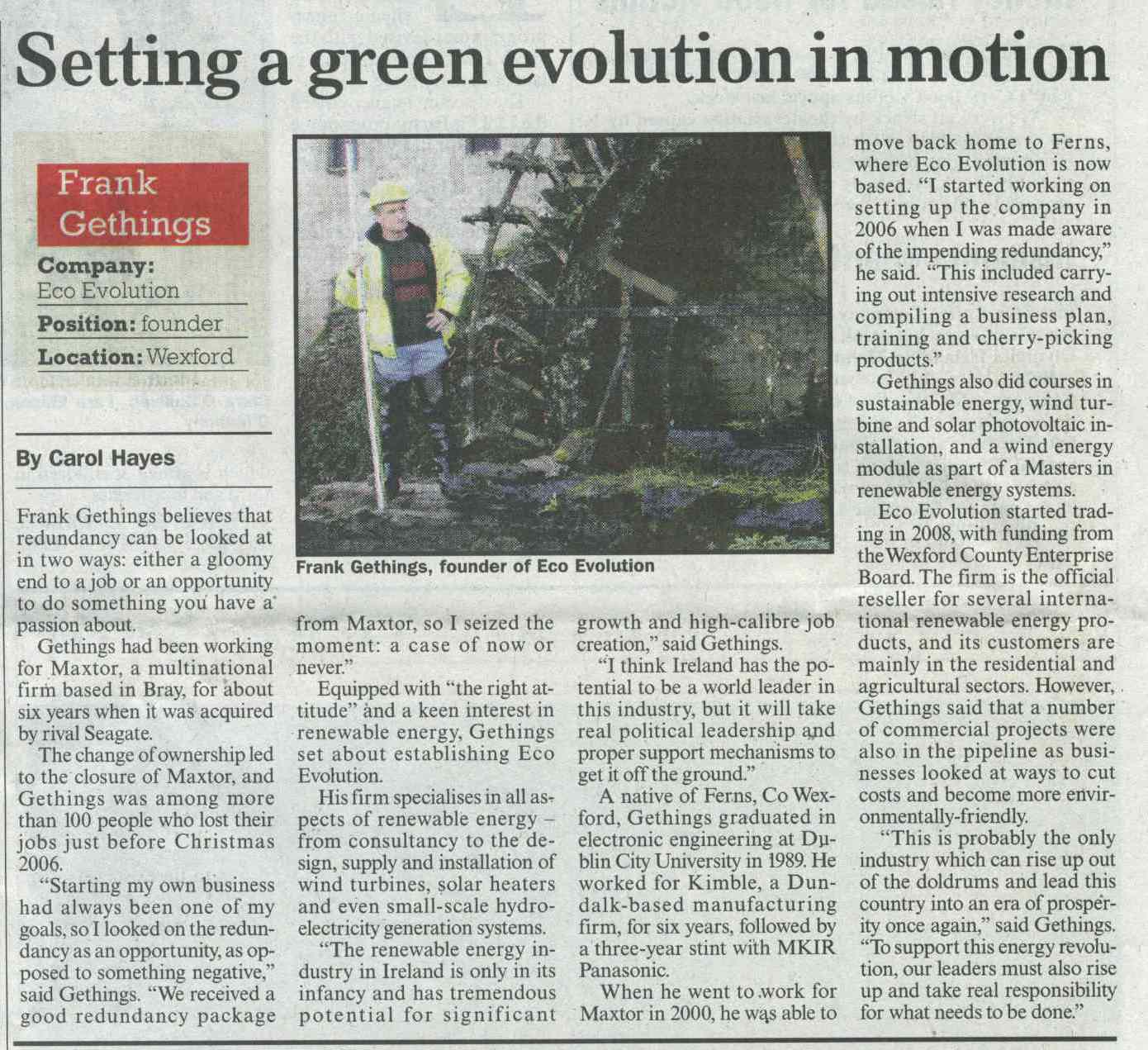
Setting a green evolution in motion – featured in the Sunday Business Post

Setting a green evolution in motion

Frank Gethings believes that redundancy can be looked at in two ways: either a gloomy end to a job or an opportunity to do something you have a passion about.

Gethings had been working for Maxtor, a multinational firm based in Bray, for about six years when it was acquired b y rival Seagate.

The change of ownership led to the closure of Maxtor, and Gethings was among more than 100 people who lost their jobs just before Christmas 2006.

‘‘Starting my own business had always been one of my goals, so I looked on the redundancy as an opportunity, as opposed to something negative,” said Gethings. ‘‘We received a good redundancy package from Maxtor, so I seized the moment: a case of now or never.”

Equipped with ‘‘the right attitude’’ and a keen interest in renewable energy, Gethings set about establishing Eco Evolution.

His firm specialises in all aspects of renewable energy – from consultancy to the design, supply and installation of wind turbines, solar heaters and even small-scale hydroelectricity generation systems.

‘‘The renewable energy industry in Ireland is only in its infancy and has tremendous potential for significant growth and high-calibre job creation,” said Gethings.

‘‘I think Ireland has the potential to be a world leader in this industry, but it will take real political leadership and proper support mechanisms to get it off the ground.”

A native of Ferns, Co Wexford, Gethings graduated in electronic engineering at Dublin City University in 1989.He worked for Kimble, a Dundalk based manufacturing firm, for six years, followed by a three-year stint with MKIR Panasonic.

When he went to work for Maxtor in 2000, he was able to move back home to Ferns, where Eco Evolution is now based. ‘‘I started working on setting up the company in 2006 when I was made aware of the impending redundancy,” he said. ‘‘This included carrying out intensive research and compiling a business plan, training and cherry-picking products.”

Gethings also did courses in sustainable energy, wind turbine and solar photovoltaic installation, and a wind energy module as part of a Masters in renewable energy systems.

Eco Evolution started trading in 2008, with funding from the Wexford County Enterprise Board. The firm is the official reseller for several international renewable energy products, and its customers are mainly in the residential and agricultural sectors. However, Gethings said that a number of commercial projects were also in the pipeline as businesses looked at ways to cut costs and become more environmentallyfriendly.

‘‘This is probably the only industry which can rise up out of the doldrums and lead this country into an era of prosperity once again,” said Gethings.

‘‘To support this energy revolution, our leaders must also rise up and take real responsibility for what needs to be done.”


Featured in the Sunday Business Post in ‘People in Business’ section:

Article


Carbon tax to drive up fuel costs

irishtimes.com – Last Updated: Wednesday, December 9, 2009, 18:59

Carbon tax to drive up fuel costs

HARRY MCGEE, Political Correspondent

The new carbon tax at a rate of €15 per tonne will result in increases of 4.2 cent in the price of petrol and almost 5c in the price of diesel from midnight tonight.

The Minister for Finance Brian Lenihan announced the measure in today’s Budget speech, saying it was designed to change behaviour to reduce greenhouse gas emissions.

“The most effective way to to put a price on carbon. This will encourage innovation by incentivising companies to bring low carbon products and services to the market,” he said.

The measure will yield a total of €250 million next year and some €330 million in a full year.

Notably, the Minister said that not all of the revenue would be ringfenced to encourage lower carbon emissions. He said some would be used to boost energy efficiency, some to support rural transport and some to alleviate fuel poverty.

He added that the tax “will also allow us to maintain or reduce payroll costs”, an indication that it will not be revenue neutral.

Some €50 million of the revenue will be used to fund measures for households at risk of fuel poverty to make their homes warmer.

The excise changes for oil, gas and kerosene will come into effect from tonight but price increases in coal, peat will not occur until May 2010.

The changes will lead to increase of an estimated 39 cent for a bale of peat briquettes and €1.79 for a 40kg bag of coal.

The latest study from the ESRI estimates the changes will cost households an average of between €2 and €3 per week, or up to €156 per year.

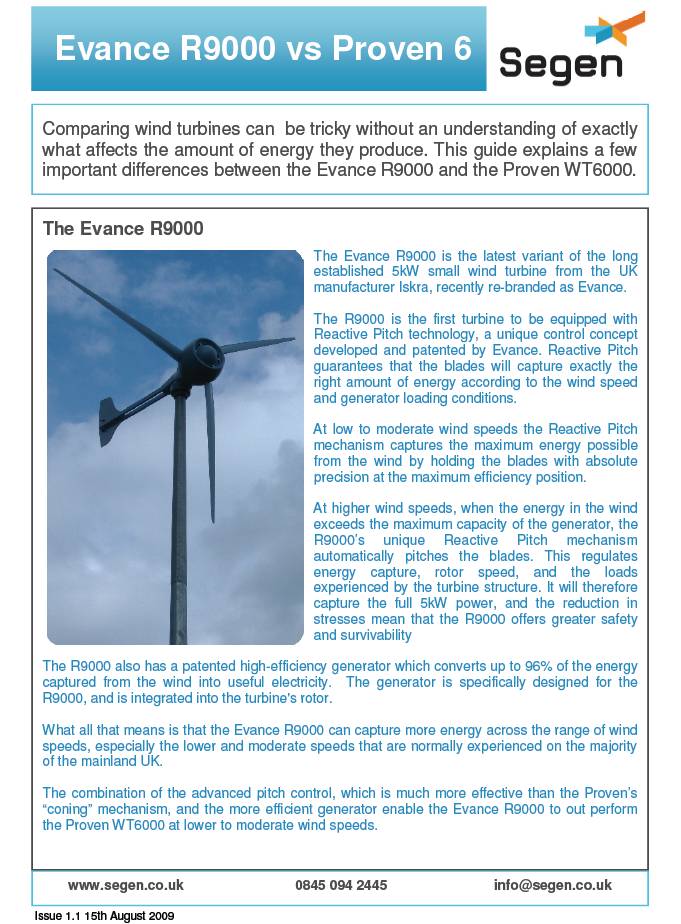
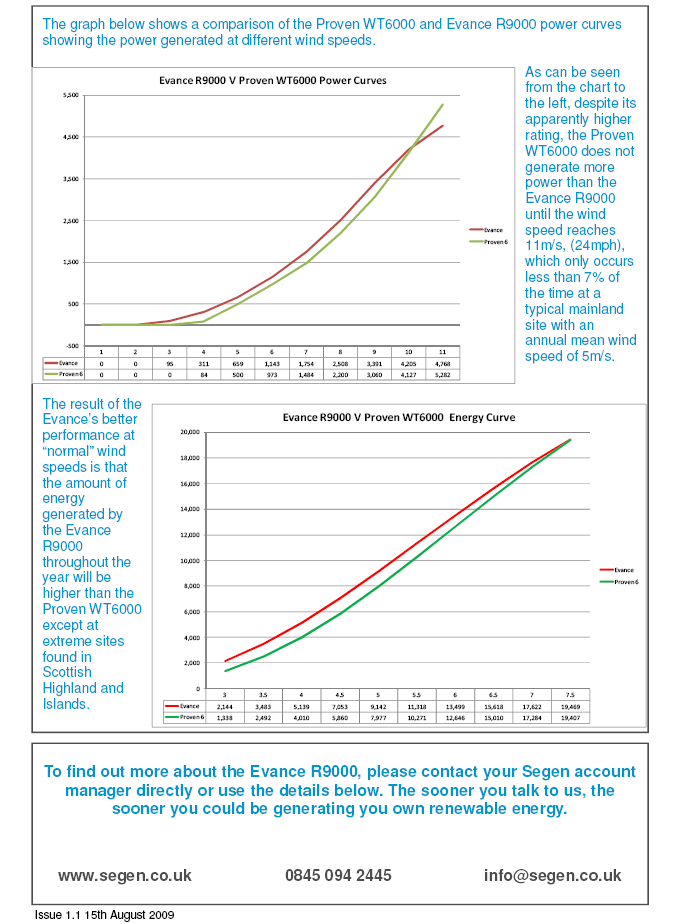
Evance R9000 Vs Proven WT6000

“The Evance R9000 is the latest variant of the long established 5kW small wind turbine from the UK manufacturer Iskra, recently re-branded as Evance.

The R9000 is the first turbine to be equipped with Reactive Pitch technology, a unique control concept developed and patented by Evance. Reactive Pitch guarantees that the blades will capture exactly the right amount of energy according to the wind speed and generator loading conditions.

At low to moderate wind speeds the Reactive Pitch mechanism captures the maximum energy possible from the wind by holding the blades with absolute precision at the maximum efficiency position.

At higher wind speeds, when the energy in the wind exceeds the maximum capacity of the generator, the R9000’s unique Reactive Pitch mechanism automatically pitches the blades. This regulates energy capture, rotor speed, and the loads experienced by the turbine structure. It will therefore capture the full 5kW power, and the reduction in stresses mean that the R9000 offers greater safety and survivability

The R9000 also has a patented high-efficiency generator which converts up to 96% of the energy captured from the wind into useful electricity. The generator is specifically designed for the R9000, and is integrated into the turbine’s rotor.

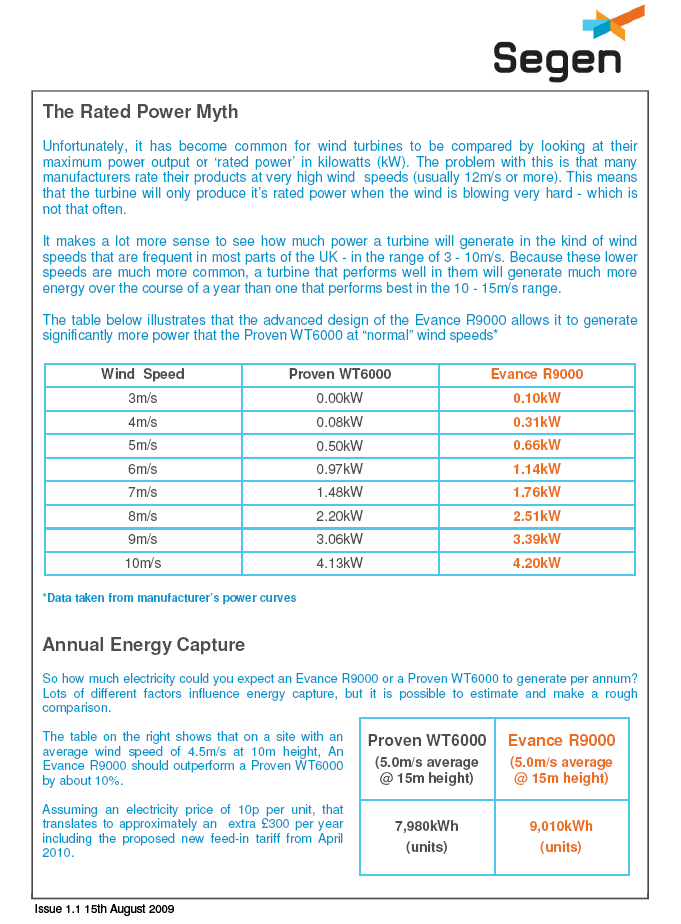
What all that means is that the Evance R9000 can capture more energy across the range of wind speeds, especially the lower and moderate speeds that are normally experienced on the majority of the mainland UK.
The combination of the advanced pitch control, which is much more effective than the Proven’s “coning” mechanism, and the more efficient generator enable the Evance R9000 to out perform the Proven WT6000 at lower to moderate wind speeds…”

Evance_Proven_1Evance_Proven_2Evance_Proven_3Evance_vs_Proven.PDF